During National Small Business Week (May 3–9), communities across the country recognize the 36 million small businesses that power the U.S. economy.
At Local First Arizona, that work isn’t confined to a single week. We work year-round to support, and shine a light on, the 650,000 small businesses operating in Arizona who make up 99.5% of total businesses in the state and employ 1.1 million people.
We know that entrepreneurs are the vital engines fueling the state’s economy, and while Arizona is ranked nationally for its startup-friendly landscape, less attention is paid to the journey entrepreneurs experience in the months and years that follow the ubiquitous ribbon cutting ceremony.
It begs the question: What does small businesses ownership look like after the startup phase?
The answer is complex, non-linear and unique to each business. For some, it is a slow crawl. For others, it feels like being shot out of a cannon. And some business owners experience stops and starts, failures and successes, until they finally land in a space that feels like a good fit.
We checked in with a handful of newer businesses to get a feel for that journey. With varied paths, and Local First Arizona support, they’ve all found their way from startup to storefront. Many of them have worked with Local First Arizona programs designed to support growth beyond the startup phase. Here’s what that growth looked like for each of them.
Trades of Brit

Brittny Johnson, founder of Trades of Brit
Brittny Johnson thinks like a chemist, and not necessarily like a marketer. She has a deep understanding of why her skincare line, Trades of Brit, is beneficial because she formulates it to specifically avoid harmful ingredients. Communicating that difference takes time in a noisy marketplace where viral scents and “get ready with me” influencers dominate attention.
“There’s a lot of miseducation on how to use products,” Johnson, who has a masters degree in chemistry, said. “I think that is the hardest part in having a skincare line. It’s hard to communicate that to people because they are so sold. They can’t get out of it.”
“I feel like I’ve played the game safe. I haven’t taken crazy, crazy risks.”
Despite those challenges, Trades of Brit has found its fans. When Johnson launched the business in 2021, she also enrolled in Local First Arizona’s We Rise business accelerator program for Black entrepreneurs. Shortly after completing the program, the brand experienced significant growth, with a retail presence in multiple locations across the Valley.
Word of mouth has been powerful for Trades of Brit, but many of her partnerships have come about organically or because a friend noticed a natural fit between the brand and their favorite retailer. It’s been a mixed bag, and Johnson is learning from each partnership.
“There needs to be so much intentionality with creating a business and it’s hard to be intentional in every aspect,” she said. “One thing I’m truly learning and wanting to be better at is finding those strategic people and partnerships to help grow the business to the next level.”
Cubanitas Kitchen
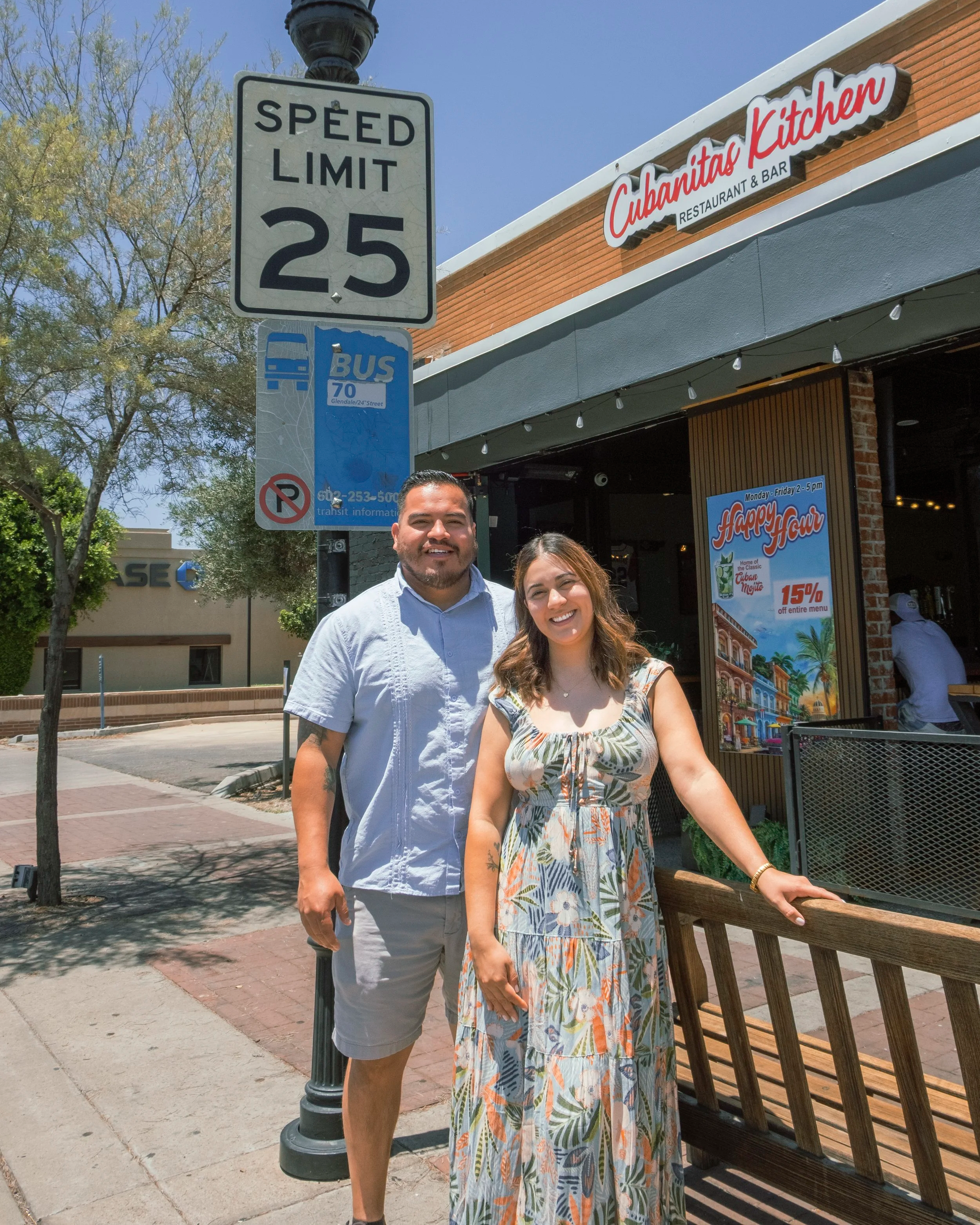
Angel Renteria and Lennis Rivas Montero of Cubanitas Kitchen
Seated at the bar of Cubanitas Kitchen, Angel Renteria can confidently say that he’s happier now — even with the ups and downs he’s experienced — than he was when he was working in the corporate world. He and his wife, who together have taken Cubanitas Kitchen from a food truck to a dine-in restaurant, have navigated a path they never expected. And now they’re seeing the kind of success they had hoped for, after finding their way into a business partnership they never saw coming.
“When we went into this, we made the agreement that no matter how hard it gets or easy, we’d be happy if we pay our bills and maintain a good home life,” Renteria said. “But for us, we’re happy we do what we love and pay our bills with it.”
The path to this moment, though, was enough to discourage anybody. The couple shuffled between operating their food truck, operating a space inside a gas station, and moving from one small storefront to another, before finding a fruitful business partnership at the 57th and Glendale Ave. location where they have been for the past 18 months.
“I tell people, ‘You’re gonna fail.’ Don’t be afraid.”
Through it all, even when they were turned down twice for business loans because their business was still too young, Renteria relied on his faith.
“I’m catholic by birth, but I don’t do church but I do believe in a higher power and God, and it’s God’s timing. That’s the only, like, universal explanation that I can put in my head and heart,” Renteria said. “Don’t get the loan, wait for me.”
Ultimately, their success came down to timing, networking and building community. Every step of their journey involved building community around the food they were making and flavors they were sharing. And every opportunity they came across, each of which felt serendipitous, orbited around a shared love for Cubanitas Kitchen.
Of course, they’re not taking any success for granted. Especially when they see other restaurant concepts, even those that appear to be successful, go under.
“It’s just timing,” Renteria said. “We’re riding the wave.”
Naked Fig Soap

Madeline Harn of Naked Fig Soap
In the summer of 2025, Madeline Harn faced what she called a “fail or scale” moment. As the owner of Naked Fig Soap, where she creates artisan soaps inspired by scent memory, Harn enrolled in Local First Arizona’s Green Business Boot Camp. In the middle of it, she had an “aha” moment.
“I actually cried during the sessions about time being a sustainability issue,” she said. “I realized that was what I needed. I was afraid of hiring anybody.”
At the time, she was working seven days a week, 10 hours a day to keep up with the orders that were coming in. At one point, the business took over her family room, leaving no space for a Christmas tree during the holidays.
“Time is measured. It’s an actual commodity that I can look at like money or equipment,” she said. “Time is a resource and it was the key to my ability to scale.”
Since that revelation, she has welcomed three employees. So while she recently drove to a Pasadena market to launch her new California-inspired line, her employees were still working to manufacture goods and fulfill orders.
“Having a team has been incredible,” Harn said. “Our pace has just tripled. We are going so fast now. All the things that will allow me to confidently grow are starting to happen.”
She found warehouse space that she shares with another maker, and she’s found ways to purchase supplies in bulk by partnering with other soap makers who need the same ingredients. It knocks the price down considerably. These are just things she had to learn along the way.
“The things I invested in six years ago are part of my bloodstream now. They’re part of the way I think.”
“I feel truly like I’ve come out of a chrysalis. I feel like I have new wings andI don’t really know how to fly but we’re flying,” she said. “It’s not lost on me what a privilege it is to have customers but also to have employees. The honor of that is crazy. What I have built with my brain and hands is contributing to somebody’s wellbeing. Someone’s livelihood is better. That’s so crazy cool.”
Hundred Mile Brewing
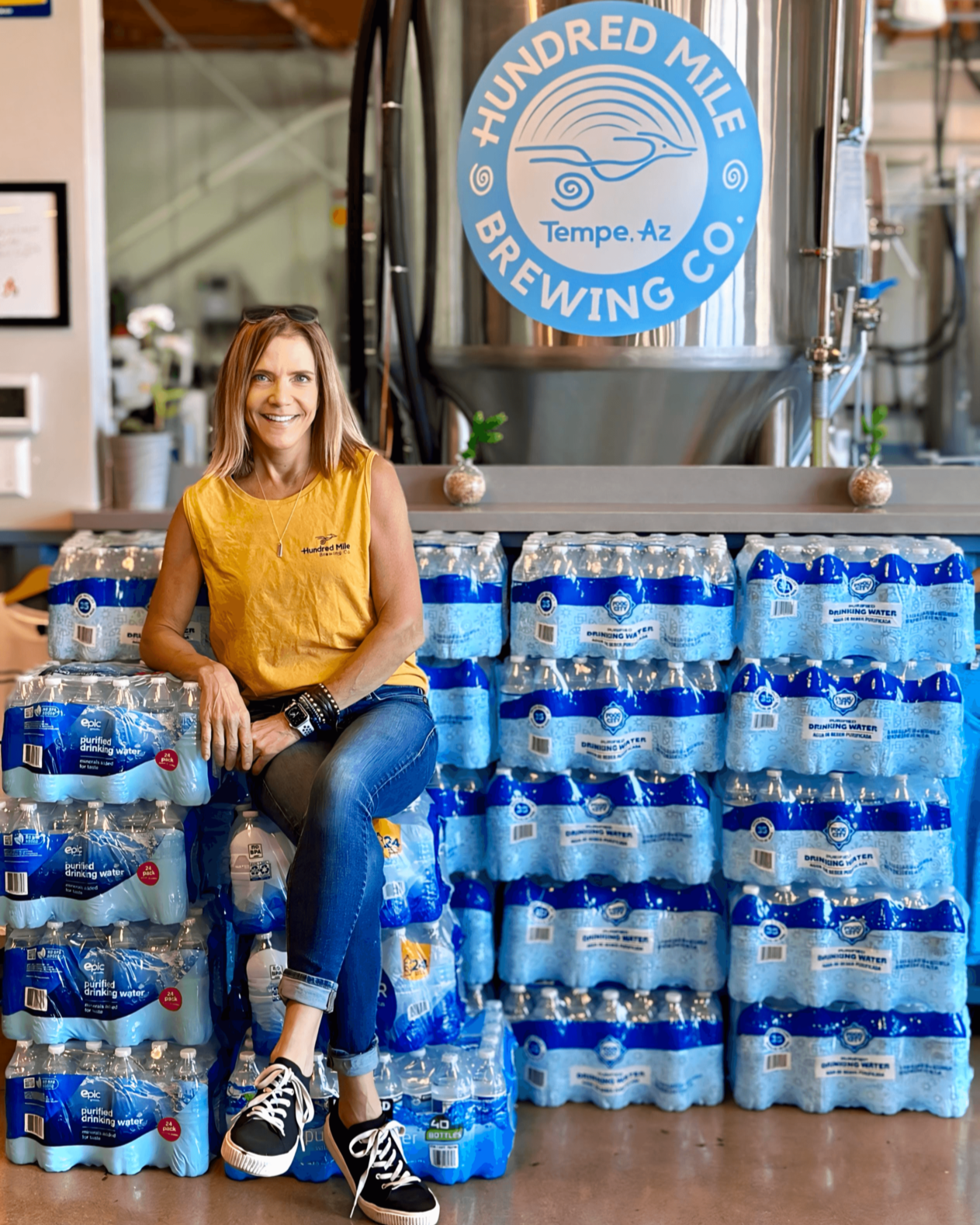
Sue Rigler of Hundred Mile Brewery
When Sue Rigler decided to take her appreciation for beer to the next level, by opening a brewery, she had a few “nevers” in her back pocket. She was never going to brew with any brewing equipment that wasn’t German. And was never going to offer food.
“My budget couldn’t afford German brewing equipment and we have food,” she said, laughing at how things turned out.
Circumstances turned her vision for Hundred Mile Brewing on its head, in part because she found a 10,000 square foot building on Tempe Town Lake that she didn’t feel like she could pass up. It was the perfect location, but the size meant she’d need a restaurant and taproom component. She’d eventually realize she would also be able to utilize some of that square footage as a dedicated event space, something Tempe sorely needed.
“I had to pivot extremely quickly,” she said. “It was either sink or swim and I’m a swimmer. I’m feisty and scrappy and competitive and my doors are not going to shut. I had to fight tooth and nail. I was in fear. You just don’t know. You have to figure it out and have good people on your team.”
“Never say ‘never.’”
For Rigler, culture was the key. Not just envisioning one, and not even drafting statements about one, but instilling it into the brewery’s operations and finding people who truly embraced it. There were some rough spots when she realized some of the people she thought were right, just weren’t a good fit.
“It takes time to paint that picture of ‘what does Hundred Mile Brewing look like’? It’s up to me to train, communicate and hire the right leadership team,” she said.
Beer, Rigler said, is an experience. Drinking one at a brewery is a communal exercise. The brewery’s culture, in her mind, should reflect that from top to bottom. And that commitment to culture seems to be paying off.
Mayor Woods loves their chips, so Hundred Mile Brewing named them after him. Three of the Valley’s mayors loved their hatch green chile burger on a recent episode of “Check, Please! Arizona” on PBS. Their wings were recently declared the best in the Valley and their beer won a gold medal by the Arizona Craft Beer Association.
“You have to be innovative and relevant. It’s the kiss of death if you think you will do the same thing over and over and be successful. You have to be fluid,” she said. “People will always love an experience and community. It’s how we make them feel, not just what we’re serving them.”
Espressions Coffee Roastery
As the owner of Espressions Coffee Roastery, Dustin Anderson has faced a few headwinds. He’s had to navigate tariffs, he’s had to manage a transition from second wave to third wave coffee, and he’s had to upgrade equipment.
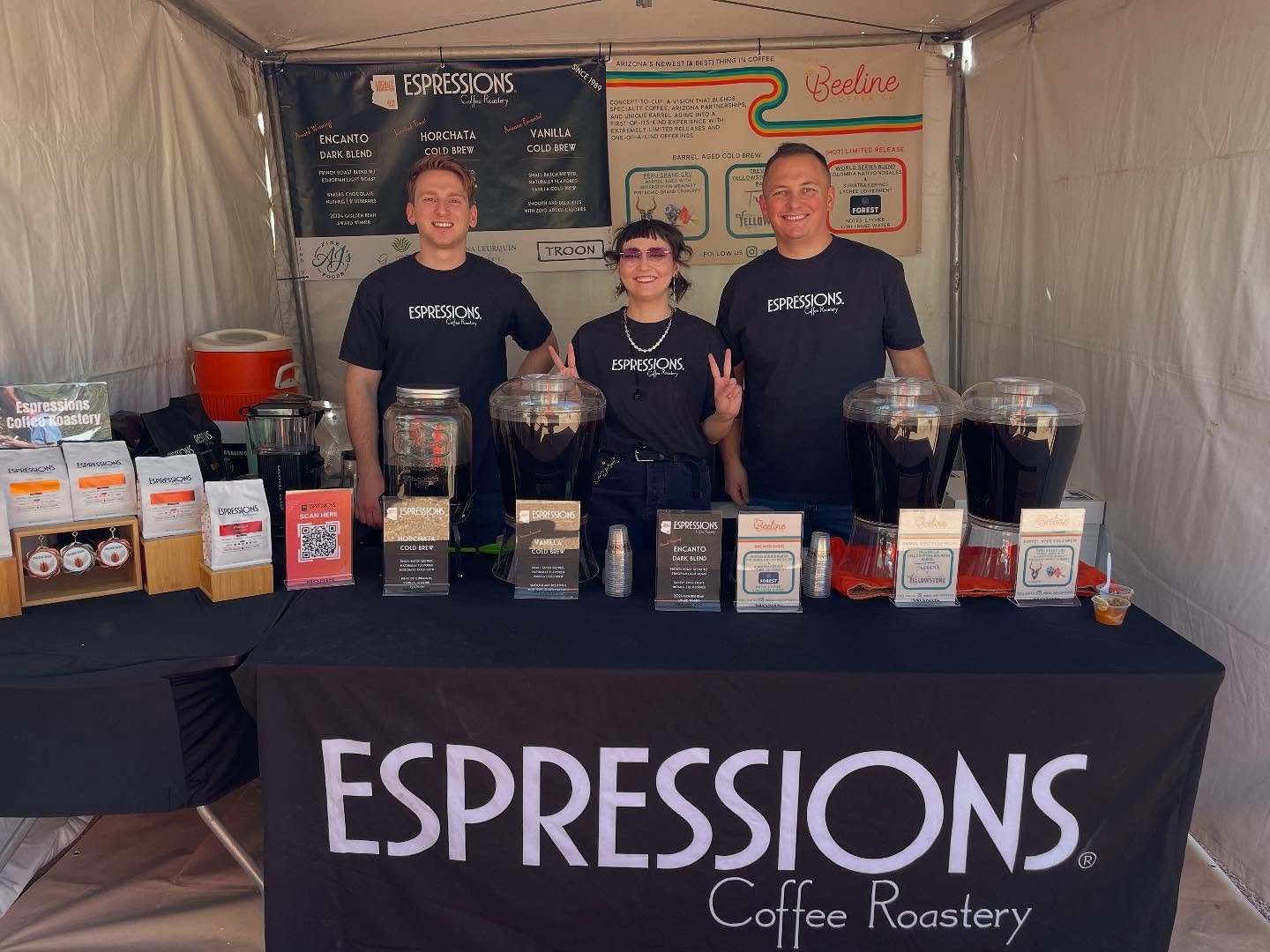
But in the midst of it, the coffee is winning global competitions, taking home two silver medals from the Golden Bean World Series.
“We couldn’t be prouder, but this year we’re winning gold,” said Spencer Galloway, who leads sales operations for Espressions.
As a wholesale roaster that also supplies anything a coffee company would need, from beans to syrups to equipment, Espressions has been around since the late 80s. Anderson bought it in 2021 and since then has been diving deeper into the specialty market.
That deep dive includes a significant investment in a new roaster that will create efficiencies and introduce new technology into the roasting process.
“We’re really trying to enter into a growth phase and see how we can expand.”
“It allows for scalability down the road as we intend to grow. It’s larger and allows us to grow the operation where we haven’t been able to do in the past,” Anderson said, noting that Espressions roasts about 200,000 pounds annually. “We truly were at capacity with how many roasts we can do in a day.”
Visibility is also a challenge, in part, because they are a coffee brand without a cafe. Events offer Espressions great exposure, but the competition in the market is tough to break through without a storefront.
“We’re constantly going against bigger companies with cafes and their brand is easily recognizable and we have to fight for that recognition,” Galloway said.
Of course, as a wholesaler, a cafe may be a catch-22. Galloway said having one would put them in competition with the cafe owners they count as wholesale customers. So, they measure success a bit differently.
“Our motto is that our success is directly associated with our customers' success,” Galloway said.
It’s more than a business philosophy — it’s a reflection of how local economies actually work.
Across Arizona, businesses grow in relationship to the communities around them. Through trust, consistency and the daily work of showing up for customers, they become part of something larger than themselves.
During National Small Business Week — and every week — that growth depends on people choosing to show up for them in return.
Shop Local: Explore and support businesses in your community through Local First Arizona’s directory.
Support Local First Arizona: Help strengthen Arizona’s local economy, expand access to resources and ensure small businesses have what they need to grow beyond the startup phase.