
Cocopah Indian Tribe turns convention and entertainment center into solar-powered revenue generator

Photos: Cocopah Indian Tribe
Federal funding will help finance a major solar installation, saving the tribe millions
When Gary Magrino presented the Cocopah Tribal Council with a proposal to build an $8 million solar farm, he wasn’t sure how they’d respond. The cost was significant for the small tribe, but the benefits to the community would be too.
Happily for Magrino, the council approved the plan to create a solar installation that will be able to generate up to 90% of the electricity needs for the tribe’s hospitality, convention and entertainment buildings.
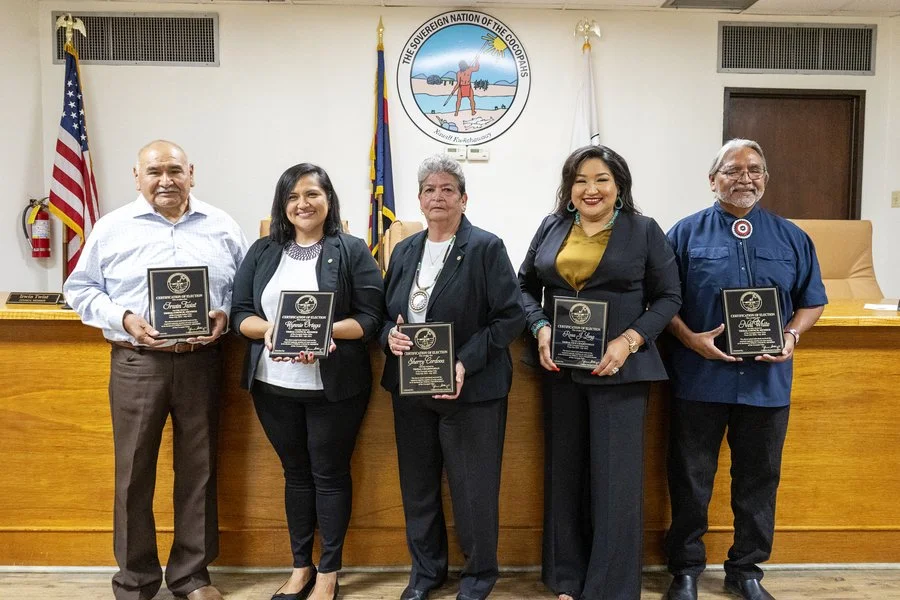
The Cocopah Tribal Council (from left): Irwin Twist, Wynnie Ortega, Chairwoman Sherry Cordova, Vice Chairwoman Rosa J. Long and Neil White
But that was just the beginning of the good news, when Magrino found an unexpected source of funding that could lower the Cocopah Indian Tribe’s costs: The federal government.
“(The council members) were ecstatic when they found out the federal government would help,” said Magrino, the tribe’s business development manager. “With a grant, we could pay this thing off in two years.”
Federal funding offsets $5 million installation costs
The tribe counts about 1,200 members, including about 400 living on its reservation in Somerton, a rural town near Yuma and the U.S.-Mexico border in southwest Arizona.
A $5 million grant from the U.S. Department of Energy will mean the tribe can realize its savings much sooner than it originally anticipated.
In addition to the Cocopah, 12 other American Indian and Alaska Native communities received U.S. Department of Energy funding to support projects that reduce costs, improve energy independence and reduce pollution.

Cocopah Indian Tribe’s Business Development Manager Gary Magrino
“Our timing was just right,” Magrino said.
$14 million in energy savings over the next few decades
When the grant funding is paired with newly expanded federal tax credits, the Cocopah Indian Tribe will only have to pay about $500,000 for the project, according to Magrino.
The solar panels are expected to save the tribe $332,000 in energy costs the first year alone, totaling more than $14 million over the course of 30 years.
Local First Arizona helped tribe with free grant writing assistance
When it came time to write the grant proposal, the tribe received assistance from the Arizona Economic Resource Center powered by Local First Arizona, a nonprofit that supports local businesses and tribal communities across the state.
Magrino said the organization’s support through the entire grant process was integral to receiving the funding.

Money saved by cutting energy costs will be reinvested into programs for the Cocopah Indian community
“I can’t say enough about Local First because we don’t have a grant writer down here,” Magrino said.
“I’m the closest thing we have, and I can‘t spell,” he joked.
More funding for community services
The tribal council will decide how to reinvest the cost savings from the solar project, but one possibility is funding its community programs to improve the quality of life for tribal members while advancing educational and economic opportunities. The tribe runs a daycare, a Head Start, a community center, a wellness center and a vocational training center.
Magrino said he also expects the project to drive job creation during the design and construction phase.
“There’s more disposable income for the tribe. We now have a lot of money we were going to put out. It’s hard dollars, because we’re not paying the utility company for that electricity,” Magrino said. “Over the course of 30 years, it adds up to a significant amount.”
Are you a rural Arizona town, tribe or nonprofit?
Local First Arizona’s Economic Resource Center may be able to help you find millions of dollars in grant funding. Visit localfirstaz.com/economic-resource-center to learn more.
