Bringing the Seeds Home: An Indigenous Coalition Reconnects Seeds, Stories and Communities
At the 2026 Good Food Forum in Prescott, Lisa Lopez brought a surprise. Ten months before, she had gotten some dried Hopi purple corn from Marcie Craynon at the Peach Springs Seed Summit. With Marcie speaking on the panel titled “Bringing the Seeds Home,” now was the time to return the favor; Lisa had brought dozens of ears of corn grown from those seeds to give back to Marcie for the heritage seed library at the Hualapai Tribe Department of Cultural Resources. Lisa, alongside Xochitl Venzor-Enrique, had grown the corn as part of the Xinachtli Youth Project, a program of Tonatierra Community Development Institute – and now the next generation of those seeds had returned home.
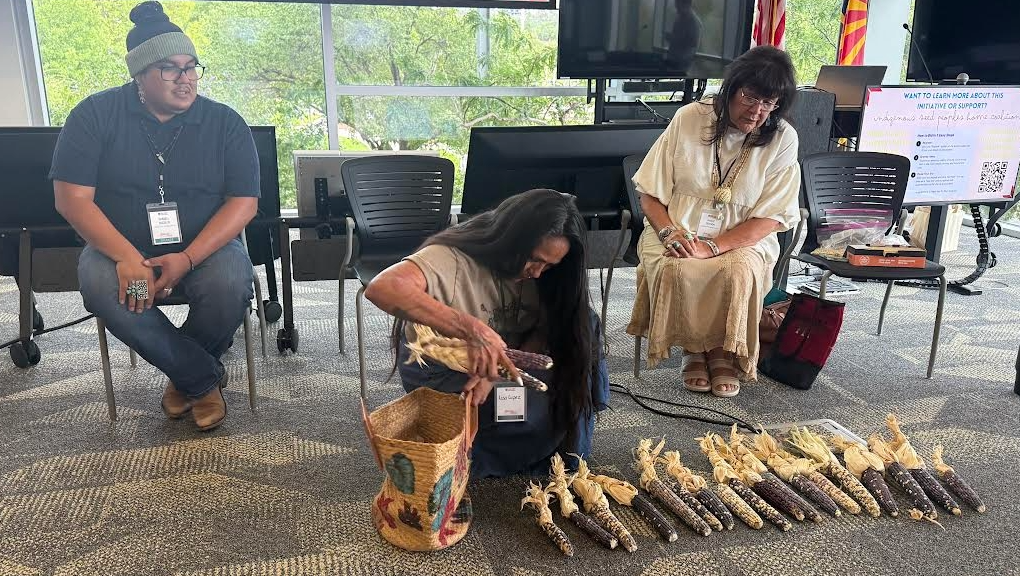
Lisa Lopez presents surplus purple corn to Marcie Craynon, who provided her with the original seed for the corn.
Lisa and Marcie met through the Indigenous Seed Peoples Home Coalition when it formed in March 2025. This coalition of Indigenous seedkeepers began as an experiment. “I was talking to my colleague Ciara Minjarez one day and we realized we were both working with Indigenous growers who were at different stages of developing seed libraries in their communities,” remembers Tristan Kitch, Resilient Foodways Program Manager of Local First Arizona. “We wanted to get everyone together and see what we could do collectively.” A year and a half later, the group has hosted three seed summits that have provided seed exchanges, food production workshops, and farm visits for over 80 Indigenous seedkeepers and community members from 10 Indigenous Nations.
“When we started meeting in spring 2025, we knew right away that we didn’t want to call what we were doing ‘seed banking,’” explains Ciara, a White Mountain Apache grower. “Seeds aren’t just seeds, they’re more than that to us as Indigenous peoples. They bring sustenance and nutrition to our people not just now but for generations before us. They share knowledge and wisdom as well. So we couldn’t call where we were storing our seeds a ‘seed bank’ because we don’t want to store living things in something cold and distant. We want to respect seeds like the living things they are.” Thus, the coalition formed around creating homes for the seed people, treating seeds not as objects to be owned but as living things to have a relationship with. “Seeds need to live in a home,” Ciara concludes.
As the coalition's work has grown, so has the meaning of being a seed person. Marcie sees herself as a “seed person.” “When you recognize your community’s past, become a cultural custodian of the seed varieties of your people, and make outreach to others, you become a seed people,” she explains. For the Coalition, seedkeeping is about kinship. It is about relationships between humans past and present as much as it is about relationships between humans and seeds.
That commitment to relationships shaped the coalition's first major initiative: seed summits. exchanging culturally significant seeds requires trust, shared experiences and opportunities to learn from one another. Seed summits would provide the setting for a collective journey among this intertribal coalition, offer educational opportunities through farm visits and workshops, and facilitate seed exchange. Marcie jumped at the opportunity for Hualapai Department of Cultural Resources to host the Coalition’s first seed summit, and when Local First Arizona secured funding for the work of the Coalition through the Arizona Community Foundation, a seed summit was scheduled for Peach Springs on October 10, 2025.
A Coalition member films the seeds and educational materials available at the Peach Springs Seed Summit seed swap.
Exchanging Seeds, Stories, and Knowledge
That seed summit was where Lisa and Xochitl got the purple corn seed from Marcie. The event began with presentations on the purpose and intentions of the Indigenous Seed Peoples Home Coalition, Hualapai ethnobotany, and the Hualapai Tribe’s efforts to include native foods in their food pantry. The afternoon consisted of site visits to two of Hualapai Tribe’s community gardens, which serve as a basis for the Tribe’s seed preservation efforts. The last workshop was a training led by Darrell Yazzie, Jr. with the Diné College Land Grant Program on best practices for seed keeping and a hands-on workshop on developing seed balls, a Traditional Ecological method to stimulate seed growth. The day was capped off with a seed exchange. Attendees from seven Nations brought seeds from their territories to trade and share.
“We’re not just exchanging our seeds, we’re passing down the story of the seeds, where they come from and their ancestral names to the next generation”, shares Xochitl. “Seeds hold language, story and connection to place. They carry the stories of those before us going back thousands of years. Seedwork has been part of my life since birth but I started planting tlaolli (corn seeds), when I was about 10 or 11 years old alongside my father. We have been planting and regrowing those same seeds as a community for 28 years now. The seed I hold today connects me to my 10-year-old self, and to my father who is now in the spirit world. It also connects us to ancestors thousands of years ago who took part in this sacred journey of seedkeeping that spans millenia.” Xochitl brought some of that corn seed to this seed summit, along with marigolds, sunflowers, devil’s claw, and other heritage plants used for food, dyes, basketry, ceremony, pollinators, soil health, and more.
These exchanges aren't a new practice. The Indigenous Seed Peoples Home Coalition is revitalizing an Indigenous tradition of sharing seeds, foods and knowledge across communities that stretches back generations.“The Big Sandy area [near Wikieup, Arizona and the sacred spring of Ha’kamwe], where my family is from, was very centrally located,” Marcie recalls. “We could trade with people in the north and south. Our language [the Yuman-Cochimi language family] extends all the way down to Baja California and west to San Diego. It brought us an understanding of foods in other areas and brought diversity to our diet and everything we used to survive. It was necessary to survive.”
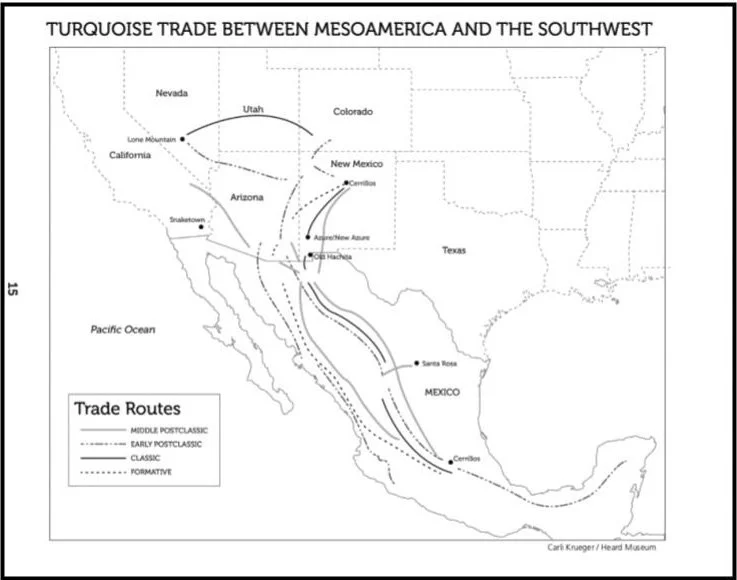
The “Turquoise Trail” is just one demonstration of historical trade between Indigenous Nations in the region. Source: Ancestral Pueblo Curriculum, Heard Museum
Xochitl has taught about these trade routes through the Xinachtli Youth Project. “About four years ago, we taught a whole summer program called ‘on the Turquoise Trail’ where through studying the trade routes students created art projects. They learned how thousands of years ago cacao from Mexico was exchanged all the way up to Chaco Canyon [in northern New Mexico] and Turquoise from the Pueblos found in what’s now southern Mexico.” She also shared that in 2011 through research interviews in Puerto Rico, including with paleoethnobotanist Dr. Jaime Pagán, she “learned that there were remnants of corn in the ancestors’ teeth dated to 1060 CE at the latest, demonstrating strong evidence that our ancestral trade of corn was across oceans.” Xochitl continues, “There has always been a lot of historical connection between nations. Just look at how far the varieties of beans and corn traveled and how they adapted to each of our lands. Through that they were able to become so important to each of our cultures, diets, and health.”
Robert Stone, owner of Hothai Farms, recalls these trade routes in action from his childhood in the Gila River Indian Community. “When I was young, folks from Tohono O’odham Nation would come to camp out and help us during our harvest. They would take back some of the surplus with them,” he recalls. “The trade routes were there strongly in the past and we still have them, but we need to prioritize them again.”
Connecting Past, Present, and Future
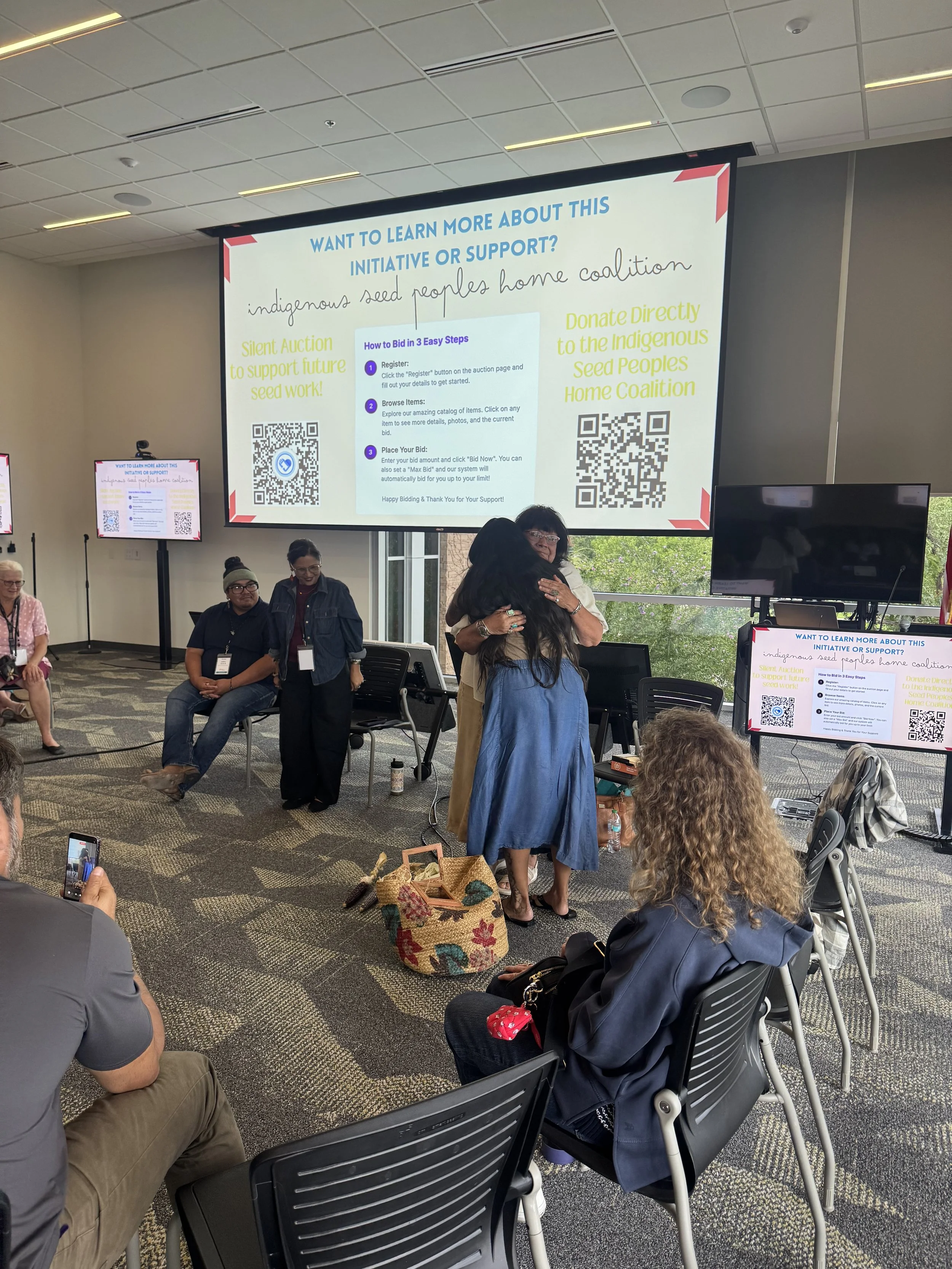
Lisa Lopez and Marcie Craynon embrace during the corn exchange as Coalition members Darrell Yazzie, Jr. and Evie Reyes-Aguirre look on.
So far, the Indigenous Seed People’s Home Coalition has rekindled these trade routes at three seed summits – in Peach Springs, in Phoenix and the Salt River Pima-Maricopa Indian Community, and in Whiteriver. The group is planning more summits for 2027 and hopes to expand knowledge exchange on its regular virtual meetings. The Coalition is currently fundraising to do just that. Coalition members and supporters have donated items for auction, and 100% of the funding from the auction, facilitated by Tonatierra, will go back into the seed summits.
“I see this Coalition going long term,” remarks Darrell Yazzie, Jr., an extension agent with Dine College who also has his own farm on Navajo Nation. “I believe this coalition has the potential in terms of developing protocol around seed saving and making blueprints for keeping seeds in line with cultural practices.”
The future of seedkeeping will not be without challenges. Climate change has been forcing seeds - and farmers - to adapt. “We planted some watermelon seeds we got from Salt River at their seed summit,” explains Marcie. “They were doing really well, but in September [2026] we had flooding from the moisture pushed up this way from Hurricane Polo in the Pacific], and it destroyed a few of them. The melons got so overwatered they literally burst.” The coalition has a time-tested solution: keep planting.
“We need to get our seeds in the ground, save the seeds from the plants that do well, and plant those to keep adapting them to this new heat,” advises Robert Stone. Darrell adds about adapting seeds to the changing climate, “Heirloom seeds are hyperadapted to specific regions. Their genetics are adapted to that specific soil, the weather patterns of that region. Compared to mass-produced seeds, it’s easier for them to adapt when things go wrong. So even if you have a bad year, that’s still helping you for the future.”
Xochitl puts it succinctly, “Everything starts with our seeds and goes back to our seeds.” They contain the past through stories and connection to ancestors. In the present, they contain sustenance and relationships within and between Indigenous Nations. And they contain the future - connections to descendants and a promise of continued community life.
“When you think about it, what we’re doing with the seed summits is all ceremony,” says Darrell. “It’s a different feeling when we’re all together. It’s like our ancestors are there with us and that heals us.”
That’s why, when Lisa Lopez presented back to Marcie the corn Tonatierra grew from the seed Marcie provided, there wasn’t a dry eye in the audience. “What we did with Tonatierra – they took our seeds and planted them and gave us the excess – that’s how we always did it,” Marcie notes. “We planted devil’s claw seeds we got from Tonatierra, and they love it here [in Peach Springs] so far. Just by having planted them, we’re feeling our responsibility to that trade route between our Nations.”
To support the work of the Indigenous Seed Peoples Home Coalition, please consider bidding for an item in the group’s charity auction. One hundred percent of the funds, facilitated by Tonatierra, will go back to the work of the Coalition.