

An artist's rendering of the Backyard Project via Bisbee Science Exploration & Research Center
Working at a decommissioned middle school could, on paper, sound like the backdrop for a creepy, horror film. For Thea Van Gorp, it’s inspiring.
She sees its potential to serve the rural southern Arizona community of Bisbee in a reimagined way, with the creation of a regenerative learning ecosystem unlike anything the town, or the surrounding Cochise County, has ever seen.
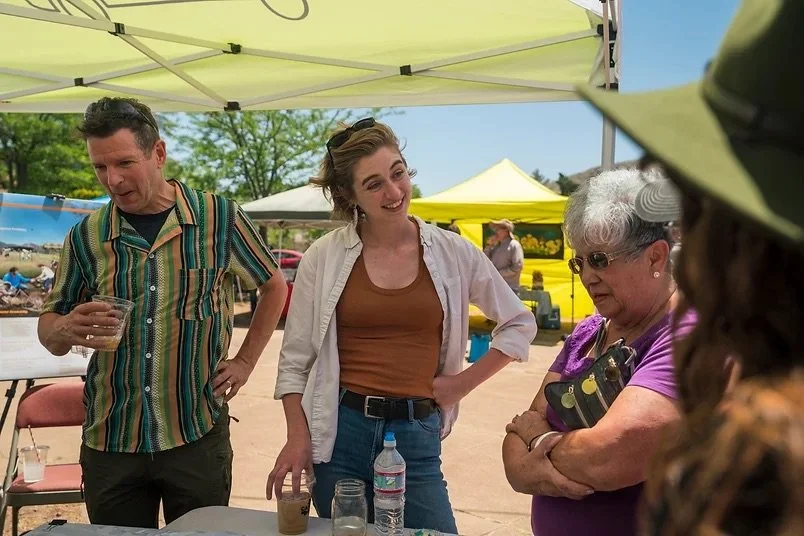
Thea Van Gorp (middle) gathering feedback from community members
The Backyard Project involves a partnership with the Bisbee Unified School District and will allow students to participate across five scientific research field stations.
The vacant school grounds were chosen to be the home base for the project, which will include access to a nearby public library annex that houses tools and seeds for the community.
“It seemed like a really good fit for us,” Van Gorp said.
As chief operating officer of the Bisbee Science Exploration & Research Center, Van Gorp guided the early planning.
The Backyard Project recently received a $150,000 federal grant from the Environmental Protection Agency to support its creation. The grant was made possible through the Inflation Reduction Act passed by Congress and signed by the president in 2021.
A community-led project
The Backyard Project will transform eight acres of unused land at the school site into a research, engagement and learning area for the entire community.
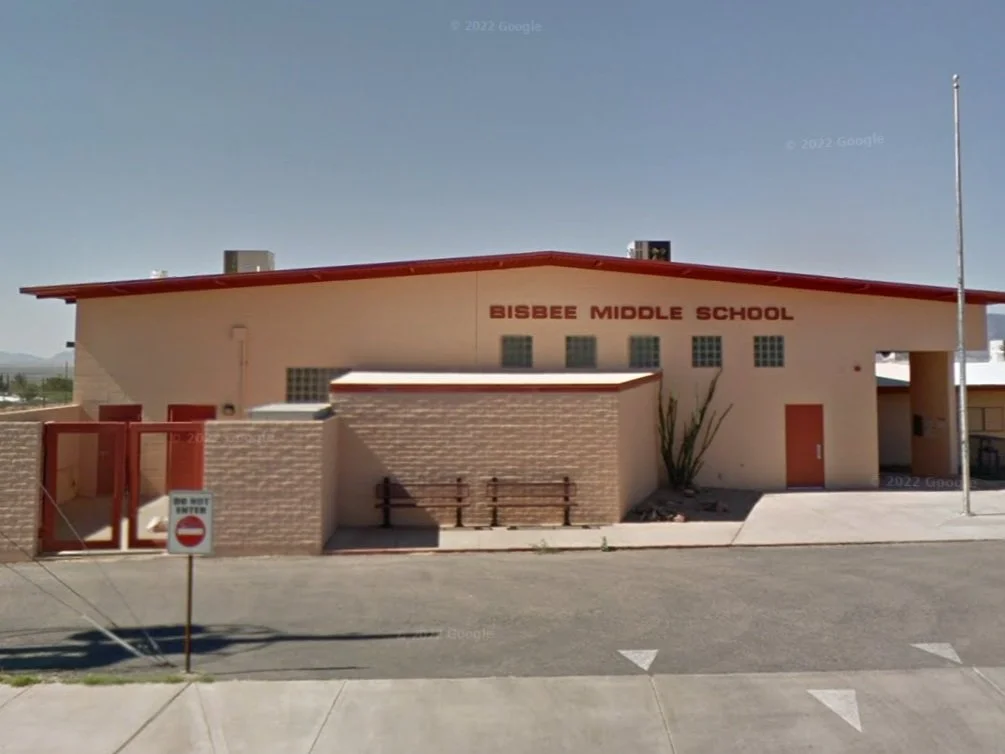
The vacant Bisbee Middle School (via Google Maps)
The organization has invested a significant amount of time and funding into community engagement for the project, making sure the public is involved with every step of the process.
Community feedback throughout the planning process has helped Van Gorp and her colleagues group public priorities for the space into focus areas that include environment, education, engagement and exercise.
“There is still some playground equipment there that gets used by the community. T-ball practice happens there. It’s really the only sort of outdoor communal space in this part of Bisbee," said Van Gorp, who was raised in Bisbee. “Pretty quickly, we realized this needed to be community-led. We have talked to anyone and everyone who was interested.”
Inviting scientists to collaborate with kids
The goal is to develop field stations that provide the appropriate space and setting for professional scientific research, while making that research accessible to teachers and students.
Conceptual renderings suggest space for water harvesting, an eco-corridor, habitat protection and a water steam field station, among other ideas.
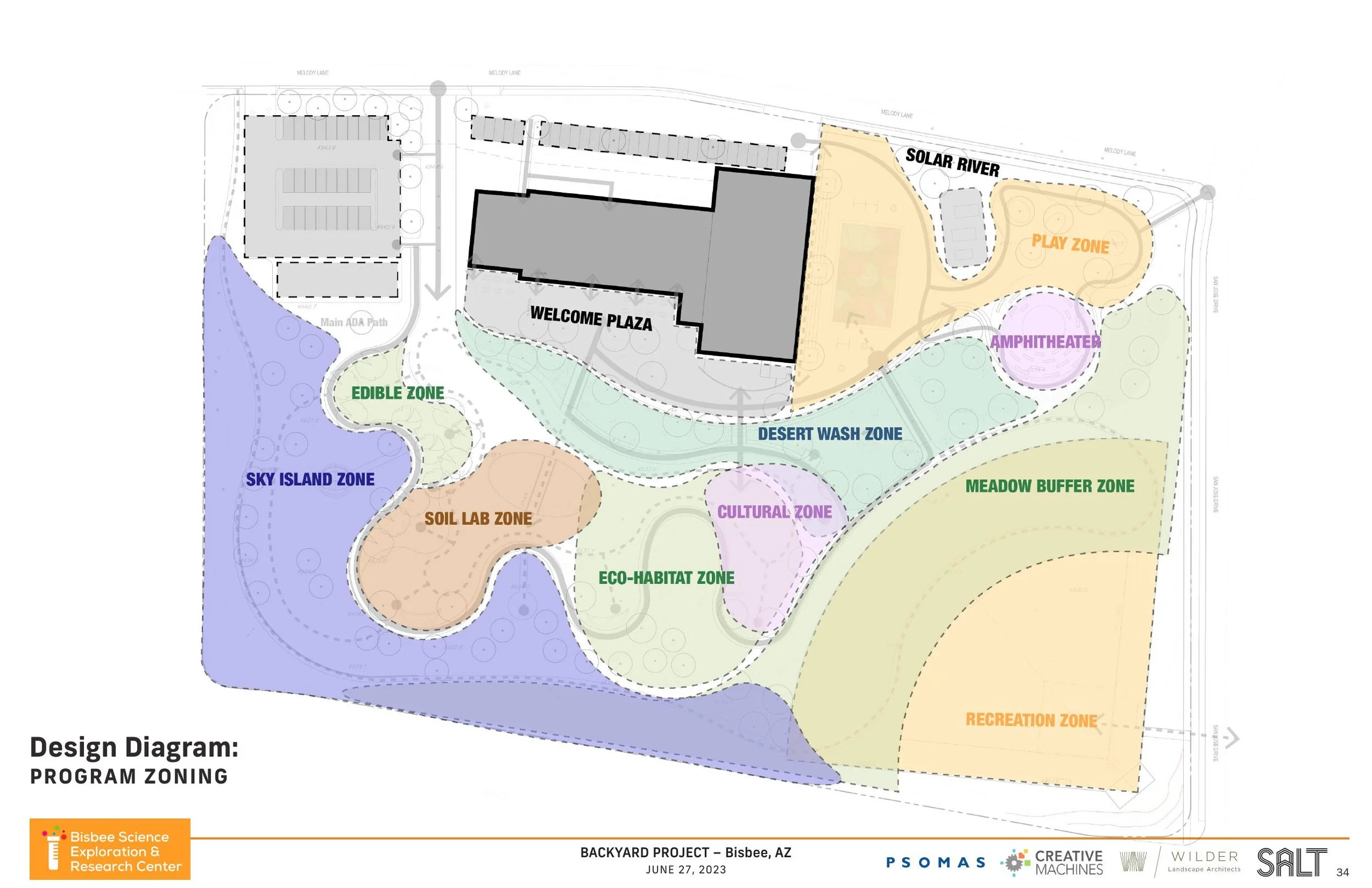
An overview of the Backyard Project
“We have real research happening, and we’re now figuring out how do we translate that to the community and students, and how can they both happen at the same time?” Van Gorp said. “We want this to be a really innovative space and it needs to be adaptable.”
About 75% of the project’s design has been finalized so far.
What’s certain is that it will include five research stations that focus on agrivoltaics, water, food, shelter and renewable energy, as well as plans for a “solar river” that calls for solar panels to be installed over canals.
Bringing science education close to home
Nearly three-quarters of Cochise County schools serve high rates of low-income families. Extracurricular programming can be limited in these rural areas.
The lack of science enrichment programs locally means that students would have to travel up to four hours round trip to participate in one, which is often a financial burden.
The school district has an elementary, a junior high, and a high school, and the area of town where the Backyard Project will live is where most of the city’s younger families are found.
Van Gorp said it seemed like a good space and a good time to connect environmental research with community stewardship in a truly interactive, tangible way.

The Bisbee Science Exploration & Research Center already hosts activities for children such as nature scavenger hunts
Next steps to completion
Thora Colot took over from Van Gorp as director this summer and will guide the next steps in building the innovative, outdoor "exploration and research playground."
Colot said Van Gorp was instrumental in leading large community engagement activities to gather feedback from residents.
“They've now given their opinion, and we're giving back what they told us they wanted,” Colot said.
“I’m starting to veer into more specifics,” Colot added. “We're talking about how these science stations can not only demonstrate some of the leading scientific thoughts on that particular topic, but they'll also show models of things that are in prototype or working form on the commercial market.”
The organization’s small but mighty team drew on inspiration from other innovative science centers across the country, including outdoor desert dwellings that student architects created at Frank Lloyd Wright’s Taliesin West.
But the Backyard Project will likely be one-of-a-kind.
“I don’t think there’s anything else like this in the country,” Van Gorp said. “There are so many projects doing cool work in communities, and we wanted to give it a spin for Bisbee.”
The Inflation Reduction Act was passed by Congress and signed into law by the president in 2022 to invest in rural America, lower the cost of prescription medications and promote clean energy.
To learn more about the Bisbee Backyard Project or volunteer, email Thora Colot at thora.colot@gmail.com.
Are you a rural Arizona town, tribe or nonprofit? Local First can help you find millions of dollars in grants. Visit localfirstaz.com/economic-resource-center to learn more.
