Beyond the Fairway: Growing Opportunity Through Golf

PGA Professional, Cesar Balgañon II (in red), with his nephew, Isaiah, at Sewailo Golf Course
Growing up in Old Pascua, a Yaqui community in Tucson, Cesar Balgañon II learned early that success wasn’t something you achieved alone. It was something you built with family, community and a commitment to creating opportunities for others.
Today, the PGA Professional and entrepreneur is applying that philosophy in a place where Indigenous business ownership might not immediately come to mind: the golf industry.
Cesar is building a coaching business, investing in cutting-edge technology and introducing more young people to the sport. His nephew, Isaiah Hernandez, now hopes to become a PGA Professional himself. For Cesar, that’s evidence of something bigger.
“I want to see Tribal members continue expanding our economic footprint into more industries and creating new opportunities for the generations coming behind us.”
Expanding that footprint requires more than ambition. Entrepreneurs need access to capital, knowledge, relationships and opportunities to enter and grow within new industries. But conventional approaches to lending don’t always provide a path that works for Indigenous business owners.
That’s the gap Local First Arizona’s Rooted Relative Fund was designed to address.
Finding His Place in the Game
Golf didn’t enter Cesar’s life until he was 20 years old.
After spending his childhood on baseball fields, Cesar was introduced to the game by his father and uncles. What began as a new challenge quickly became something much bigger than a sport.

Golf has become a family affair for Cesar Balgañon II, pictured with his father, Cesar Balgañon Sr., former NBA player Jason Terry and his uncle Angel Mendez at the Jayson Tatum Foundation Golf Tournament in St. Louis. Family first introduced Cesar to the game that would eventually become his career and business.
As he spent time around PGA Professionals, he saw the impact they could have beyond teaching someone how to swing a golf club. They built confidence, created relationships and changed lives.
Eventually, Cesar became a PGA Professional himself, serving as assistant general manager at Sewailo Golf Club before making the leap into full-time independent golf instruction.
Entrepreneurship gave him the freedom to build a coaching business around his own vision, but it also required him to become a student all over again.
“The more you move up the ladder of great teachers and coaches, a lot of them will tell you, ‘I thought I knew a lot. Turns out I don’t know anything,’” he said. “I’m forever going to be a student of the game.”
That mindset now extends beyond golf instruction. Cesar continues studying coaching methods, experimenting with emerging technology and developing the business skills needed to turn his expertise into a sustainable enterprise.
“If you’re not growing,” he said, “you’re dying.”
Rethinking Who Gets Access to Capital

Armando Carrillo, Business Lending Strategist at Local First Arizona
As Cesar’s business grew, he saw an opportunity to invest in launch monitor technology that could transform his coaching. The equipment would provide detailed swing analysis, personalized reports and measurable feedback — capabilities increasingly expected from top golf instructors.
The investment was significant.
But pursuing traditional financing felt intimidating and impersonal.
That’s one of the barriers the Rooted Relative Fund was created to address.
Rather than relying solely on conventional measures to determine who gets access to business capital, Rooted uses a character-based, relationship-driven lending approach designed specifically for Indigenous entrepreneurs. That means understanding the entrepreneur, the business and the opportunity behind the application.
For Cesar, the difference was apparent when he connected with Armando Carrillo, a business lending strategist with Local First Arizona.
“One of the first things Armando told me was, ‘We’re not here to be sharks,’” Cesar recalled. “‘If something comes up, tell us. We understand that life happens. We’re here to help you get to the next level.’”
The experience changed how Cesar thought about borrowing — and about what he could build.
“Someone trusting you and believing in you before you believe in yourself is so important.”
That trust isn’t a substitute for responsible lending. It’s a different way of evaluating potential — one that can open doors for entrepreneurs whose opportunities may not fit neatly within conventional lending models.
For Cesar, access to capital opened the door to investments that could make his business more competitive and expand what he could offer.
What Capital Makes Possible
WHAT CAN CAPITAL UNLOCK?
A new piece of equipment. Another employee. A larger contract. A new service. Entry into a new market.
For a local business owner, access to capital isn’t the outcome. It’s access to what comes next.
Local First Arizona’s Rooted Relative Fund uses a character-based, relationship-driven approach to lending designed for Indigenous entrepreneurs. By looking beyond conventional lending models, the fund helps expand access to the capital business owners need to grow, build assets, create opportunity and keep more economic power rooted in Indigenous communities.
The new launch monitor elevated the coaching experience for Cesar’s students, giving them detailed performance reports, swing videos and objective data they could continue using long after a lesson ended.
He has continued investing in technology as the business has grown, including an AI-powered putting system he has used at business and networking events.
For Cesar, those tools aren’t simply equipment purchases. They expand what he can offer, where he can offer it and who he can reach.
And sometimes the return on that investment can’t be measured only in revenue.
Cesar lights up when he talks about introducing young people to the game.
During one junior clinic, he used the launch monitor for a long-drive competition.
“I didn’t think it’d be a huge hit,” he said.
Instead, the children crowded around the screen after every swing, cheering one another on and eagerly comparing distances.
“They would run over and look at the numbers. They just wanted to see how far someone hit it.”
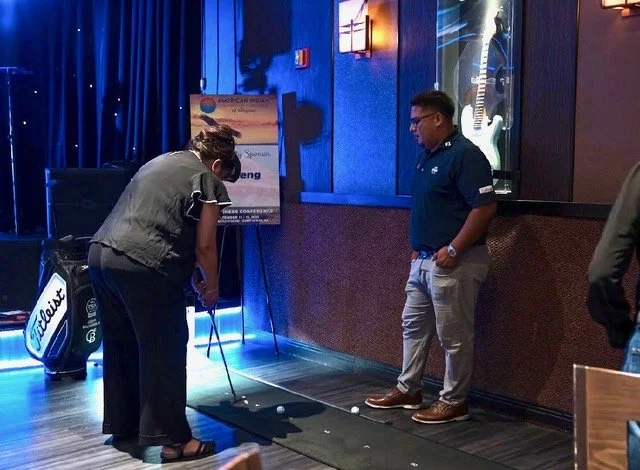
Access to capital has helped Cesar Balgañon II invest in technology like his AI-powered PUTTR System, expanding what he can offer clients and creating new ways to introduce people to the game.
Keeping young people engaged is one of the biggest challenges any coach faces. The technology Cesar purchased to strengthen his business had also become another tool for sparking curiosity and creating an entry point into a sport some young people might never otherwise have considered.
Growing the Economic Footprint
Cesar isn’t interested in building opportunity only for himself.
He sees golf as an industry where more Indigenous people can build careers, develop expertise and eventually own businesses of their own.
That matters because economic opportunity isn’t only about creating more jobs.It’s also about expanding who has the capital, knowledge, relationships and ownership needed to create those jobs in the first place.
Cesar sees a future where Indigenous professionals participate throughout the golf industry — as players, instructors, operators and business owners.
And he’s already beginning to see what that future might look like.
His nephew, Isaiah, first picked up a golf club through one of Cesar’s youth programs. Today, Isaiah wants to become a PGA Professional.
When Isaiah told him, Cesar admits it nearly brought him to tears.
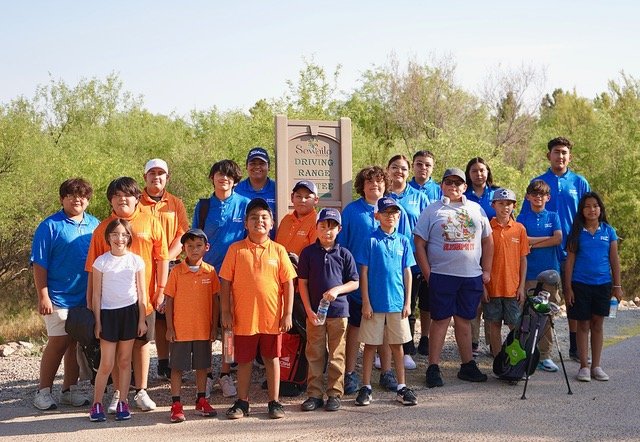
Cesar Balgañon II with young golfers at Sewailo Golf Club in Tucson. Introducing young people to golf is part of Cesar’s larger vision for expanding access to the game — and helping the next generation see the careers, connections and opportunities that can exist around it.
“I want him to be even bigger,” Cesar said. “He won’t have to learn things the hard way that I did. As long as he listens and applies himself, he’s got all the resources and mentorship he can find.”
That’s how economic opportunity can compound.
One entrepreneur gains access to capital and invests in a business. That business creates expertise, relationships and opportunities. Someone coming behind him starts with access to knowledge and mentorship the previous generation had to build for itself.
And over time, individual opportunities can add up to something much larger: more Indigenous entrepreneurs building assets, entering new industries, creating jobs and expanding the economic footprint of their communities.
Rooted Relative Fund didn’t create Cesar’s vision. It gave an entrepreneur with a vision access to capital that could help him pursue it.
That’s the larger opportunity behind relationship-based lending. When more Indigenous entrepreneurs have access to capital through approaches designed to recognize their businesses and potential, more people have the opportunity to build wealth, create opportunity for others and keep economic power rooted in their communities.
Of Related Interest:
From Vision to Venture: How Local Capital Helped a Navajo Entrepreneur Scale
Follow Cesar at @cb2pga on Instagram, or visit his website at cbiigolf.com