Arizona’s Opportunity Frontier: New Data Insights for Tribal and Rural Economies

Eric Trevan
Eric Trevan will admit that the phrase “economic leakage” isn’t that common and it’s one that sparks a bit of conversational curiosity. To the average individual, it sounds like something that needs to be cleaned up. And from an economic growth standpoint, it kind of is.
“It's simply where people are leaving your area to spend money somewhere else,” he said. “Sometimes you have to drive to an urban area from a rural one, so that means those dollars are leaking outside of your economy.”
Trevan knows about this phenomenon because he has a Ph.D. in economics and, along with a partner, he founded the Arizona-based economic analytics firm aLocal. That firm recently completed an analysis in partnership with the Tonto Apache Tribe that detailed the economic leakage in Arizona’s rural and tribal communities.
And the report revealed a wealth of opportunity for the state outside of its already-bustling metro areas.
“Rural communities have such a great opportunity because they can work on things that are small that make a huge difference,” Trevan said. “They don’t need to recruit a data center or solar farm. They can look at ‘Where am I buying my shoes? What if I just bought my shoes here? What if everybody did that?’”
These kinds of questions, related to economic development opportunities, are the kinds that are asked at Local First Arizona’s Rural Policy Forum, an annual convening of economic development professionals across the state’s tribal and rural communities. Topics discussed at this year’s forum — held in Thatcher in August — included infrastructure financing, workforce development, housing and resiliency.
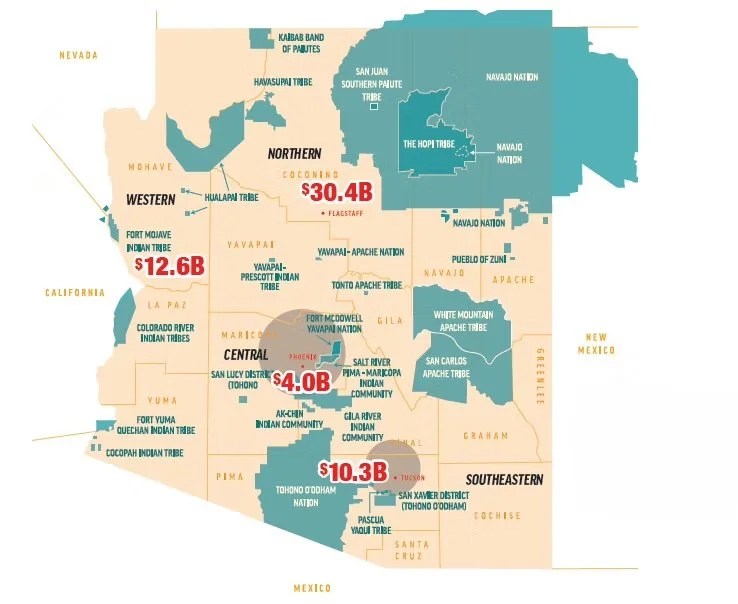
Every dollar invested in these rural or tribal areas results in $1.70 or an economic multiplier of 1.7x
At the event, Trevan told attendees that every municipal and tribal government across the state would have one year of free access to aLocal’s economic analytics platform thanks to the support of the Tonto Apache Tribe. If there was any question about the value of the platform, the rural and tribal analysis developed by aLocal for Local First Arizona offers a glimpse at what is possible.
The report revealed that rural Arizona is home to more than $57 billion in untapped growth opportunities that, if fully activated, could offer the potential of 5.2 million new jobs. Native Nations alone are home to $17.6 billion in economic opportunity. In addition, the report revealed that every dollar invested in rural and tribal communities results in $1.70 in economic output.
Economists like Trevan would call that an economic multiplier of 1.7x.
“This shows places where dollars are leaving their economy,” Trevan said of the AI-powered analysis aLocal provides.
Trevan said aLocal just needs a location to analyze, and once it does, it will determine what types of businesses are in demand, produce revenue estimates, and illustrate what the employment picture looks like. These types of insights allow communities to more effectively plan, knowing exactly what opportunities and industries it could capitalize on.
And it’s all done in minutes, not months, which has been the traditional timeline for economic analysis.
“It can be in the room when you’re brainstorming,” Trevan said. “We think it can change the way people work towards action.”
As for Arizona’s rural and tribal economic landscape, the aLocal report revealed that the top industries promoting economic leakage in smaller communities are professional industries like accounting and legal, scientific and technical services, wholesale and retail trade, healthcare and social assistance, and real estate.
“Basically, because those businesses are non-existent, the economy is not operating at an optimal level,” Trevan said. “We don’t say a community needs something. We provide equity and parity in the analytics space so they can make their own decisions. Just because something isn’t in demand, doesn’t mean something shouldn’t exist. Our job is to make analytics accessible, affordable and represent the community.”
At this year’s Arizona Association for Economic Development (AAED) Fall Forum, Trevan joined Local First Arizona Founder and CEO Kimber Lanning and Tonto Apache Chairman Calvin Johnson to share insights from their collaborative work in a session titled “Targeting Investment in Rural and Tribal Communities.”
Their presentation further emphasized how the partnership between the Tonto Apache Tribe, aLocal and Local First Arizona is helping shift the narrative — from documenting economic leakage to driving game-changing local investment. As municipal and tribal governments in Arizona take advantage of the Tonto Apache Tribe’s funding support and access aLocal’s platform, these communities can use data-driven insight to identify untapped business opportunities and strengthen local economies across the state.
“It's great that aLocal can work with Local First Arizona and the Tonto Apache Nation to help build strong economies throughout rural Arizona,” said Trevan.
The collaboration stands as a model of how shared investment and data transparency can spark tangible action. What began as a single analysis with the Tonto Apache Tribe has evolved into a statewide effort to ensure rural and tribal communities have the tools, knowledge and autonomy to capture the value that’s been leaving their economies for too long.
Related Information:
Explore the findings: [Read the report]
Learn about Rural Policy Forum: [See highlights and resources]
To learn more about aLocal: click here.